A Knee Injury Leaves You Feeling Unstable
A sudden twist, awkward landing, collision, or change in direction can place considerable stress on the ligaments that stabilise the knee. Sometimes the result is relatively mild. In other cases, one or more ligaments may be partially or completely torn.
Knee ligament tears can cause pain and swelling, but one of the more telling symptoms is instability –the feeling that the knee may buckle, shift, or give way when walking, turning, running, or returning to sport.
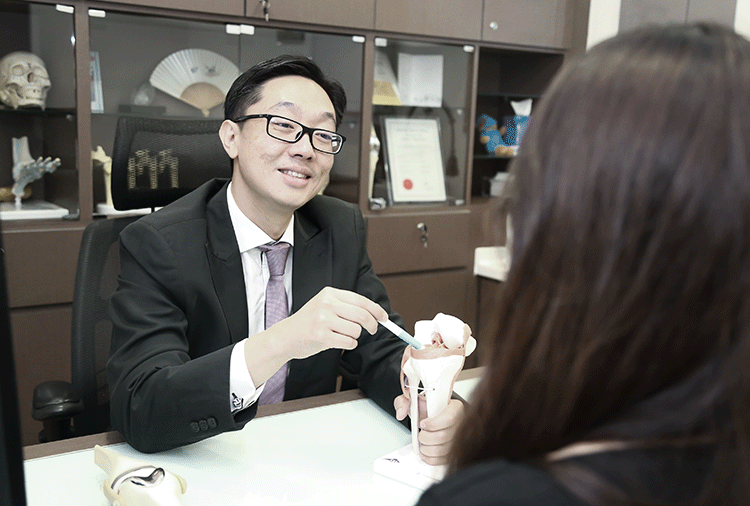
At Liberty Orthopaedic Clinic, Dr Lee Eu Jin assesses knee ligament injuries, including ACL, PCL, MCL and LCL tears. Treatment depends on which ligament is affected, the severity of the injury, the degree of knee instability, associated injuries, and the patient’s activity needs.
What Is a Knee Ligament Tear?
Ligaments are strong bands of connective tissue that connect bones and help keep the knee stable as it moves.
The knee has four main ligaments:
- Anterior Cruciate Ligament (ACL)
- Posterior Cruciate Ligament (PCL)
- Medial Collateral Ligament (MCL)
- Lateral Collateral Ligament (LCL)
A knee ligament injury occurs when one of these structures is stretched or torn beyond its normal capacity. Depending on the mechanism of injury, more than one ligament may be affected at the same time.
What Is the Difference Between an ACL, PCL, MCL and LCL Tear?
Anterior Cruciate Ligament (ACL)
The ACL runs through the centre of the knee and helps control forward movement and rotation of the shin bone.
ACL tears frequently occur during sports involving sudden stops, changes in direction, pivoting, or awkward landings.
Posterior Cruciate Ligament (PCL)
The PCL also sits within the knee and helps prevent the shin bone from moving too far backwards.
PCL injuries can occur when a strong force pushes the shin backwards while the knee is bent, such as during certain sports injuries, falls, or road traffic accidents.
Medial Collateral Ligament (MCL)
The MCL runs along the inner side of the knee and helps resist forces pushing the knee inwards.
It can be injured following a direct impact to the outside of the knee or during twisting movements.
Lateral Collateral Ligament (LCL)
The LCL is located along the outer side of the knee and helps stabilise it against forces coming from the inside.
LCL injuries are less common and may occur together with injuries to other structures in the knee.
What Causes a Knee Ligament Tear?
Knee ligament injuries are commonly associated with sports, although they can occur during everyday accidents as well.
Possible causes include:
- Sudden changes in direction
- Pivoting while the foot remains planted
- Landing awkwardly from a jump
- Sudden stopping or deceleration
- Direct impact to the knee
- Falls
- Contact sports
- Road traffic accidents
Football, basketball, netball, rugby, skiing and other activities involving rapid changes in direction can place the knee ligaments under considerable stress.
What Does a Torn Knee Ligament Feel Like?
Symptoms depend on which ligament has been injured and the severity of the tear.
Common symptoms may include:
- Sudden knee pain
- Swelling
- Bruising
- Difficulty walking
- Reduced range of movement
- Tenderness around the injured ligament
- A popping sensation or sound at the time of injury
- A feeling that the knee is unstable
- The knee buckling or giving way
Not every ligament tear causes severe or persistent pain. In some cases, the initial pain and swelling improve while instability remains.
Why Does My Knee Still Feel Unstable Even Though the Pain Has Improved?
Pain and stability are not the same thing.
After the initial inflammation settles, the knee may feel considerably more comfortable. However, if an important stabilising ligament has been significantly damaged, certain movements can still cause the knee to shift or give way.
Muscles around the knee can sometimes compensate for ligament damage during everyday activities. Instability may therefore become more noticeable when running, pivoting, changing direction, or returning to sport.
Persistent instability after a knee injury should be assessed, particularly if the knee repeatedly gives way.
How Serious Is a Knee Ligament Tear?
Ligament injuries can generally be described according to their severity:
Grade 1 – Mild sprain
The ligament has been stretched but remains intact.
Grade 2 – Partial tear
Some ligament fibres have torn, which may result in increased looseness or instability.
Grade 3 – Complete tear
The ligament has torn completely and may no longer provide normal joint stability.
The grade alone does not determine treatment. The ligament involved, degree of instability, associated injuries, activity level and functional requirements also need to be considered.
Can More Than One Knee Ligament Tear at the Same Time?
Yes. Some injuries affect several knee structures simultaneously.
A significant twisting injury or high-energy trauma may damage two or more ligaments. The meniscus, cartilage or other structures within the knee may also be injured.
These are sometimes referred to as multi-ligament knee injuries and require careful assessment because treatment may differ from that of an isolated ligament tear.
How Is a Knee Ligament Tear Diagnosed?
Assessment usually begins with understanding how the injury happened and what symptoms have developed since.
The knee may then be examined for:
- Swelling
- Tenderness
- Range of movement
- Joint stability
- Areas of pain
- Signs of associated injury
Imaging may also be recommended.
X-rays can help identify fractures or other bony injuries.
MRI scans provide more detailed images of the ligaments, menisci, cartilage and other soft tissues within the knee.
Clinical examination and imaging findings are considered together when determining the extent of the injury and appropriate management.
Can a Torn Knee Ligament Heal Without Surgery?
Some knee ligament injuries can be managed without surgery.
Non-surgical treatment may include:
- Activity modification
- Bracing when appropriate
- Physiotherapy
- Strengthening exercises
- Balance and movement training
- Gradual return to activity
Certain MCL injuries, for example, may heal with appropriate conservative treatment.
Other ligament injuries require a more individualised decision. An ACL tear may be treated non-surgically in some patients, while reconstruction may be considered for those experiencing ongoing instability or wishing to return to activities involving pivoting and rapid changes in direction.
When Might Knee Ligament Surgery Be Considered?
Surgery is not automatically required simply because a ligament is torn.
It may be considered when:
- The knee remains functionally unstable
- The knee repeatedly gives way
- The patient wishes to return to pivoting or high-demand sports
- More than one ligament has been significantly injured
- Other structures in the knee have also been damaged
- Symptoms continue despite appropriate rehabilitation
Depending on the ligament and injury pattern, surgery may involve ligament repair or reconstruction.
What Is Knee Ligament Reconstruction?
When a damaged ligament cannot provide sufficient stability, reconstruction may be considered.
Rather than simply stitching the torn ligament together, some procedures use a graft to recreate the function of the damaged ligament.
ACL reconstruction is one example. Liberty Orthopaedic Clinic’s existing services include arthroscopic ligament reconstruction of the knee as part of its orthopaedic and sports surgery care.
The surgical approach depends on the ligament involved and the individual injury.
How Long Does It Take to Recover From a Knee Ligament Tear?
There is no single recovery timeline for every knee ligament injury.
Recovery depends on factors such as:
- Which ligament is injured
- Whether the tear is partial or complete
- Whether multiple structures are involved
- Whether surgery is required
- Muscle strength and knee function
- Rehabilitation progress
- The activities or sports the patient wants to return to
Returning to sport is usually based on functional recovery rather than time alone. Strength, movement control, stability and confidence in the knee all need to be considered.
When Should You See an Orthopaedic Surgeon for a Knee Injury?
Consider an orthopaedic assessment if:
- The knee swells significantly after an injury
- You heard or felt a pop when the injury occurred
- Walking or bearing weight is difficult
- The knee feels unstable
- The knee repeatedly gives way
- Pain or swelling persists
- You are unable to return to your usual activities or sport
Assessment can help determine which structures have been injured and whether rehabilitation, further imaging, or other treatment may be appropriate.
Frequently Asked Questions About Knee Ligament Tears
Can you walk with a torn knee ligament?
Some people can still walk with a ligament tear, particularly after the initial pain and swelling have settled. Being able to walk does not necessarily mean that the ligament is intact.
Which knee ligament is most commonly injured?
The ACL and MCL are among the more frequently injured knee ligaments, particularly during sports. The type of ligament affected depends largely on how the injury occurred.
Does every ACL tear require surgery?
No. Treatment depends on knee stability, associated injuries, activity requirements and individual circumstances. Some patients may be managed with rehabilitation, while others may be considered for ACL reconstruction.
Can a knee ligament tear get worse if you keep playing sports?
Returning to activities that involve pivoting, jumping or sudden changes in direction while the knee remains unstable may result in repeated giving-way episodes and further injury. Assessment and rehabilitation are advisable before returning to higher-demand activities.
Is a knee ligament tear the same as a meniscus tear?
No. Ligaments stabilise the knee by connecting bone to bone. The menisci are cartilage structures that help distribute load and provide cushioning within the knee. Both can be injured during the same event.
Is Your Knee Still Giving Way After an Injury?
Pain may settle before knee stability returns. If your knee continues to buckle, shift, or feel unreliable after an injury, an assessment can help identify whether a ligament or another structure within the knee has been damaged.
Book a consultation with Dr Lee Eu Jin at Liberty Orthopaedic Clinic for an assessment of knee ligament injuries and to discuss treatment options based on your condition, activity level and recovery goals.